2026 July 1st – Front Building Update
Summary: the front building (formerly the church sanctuary) is pending demolition. All stained-glass windows will be retrieved asap. We continue to meet as a community in our Hall, at rear of property.
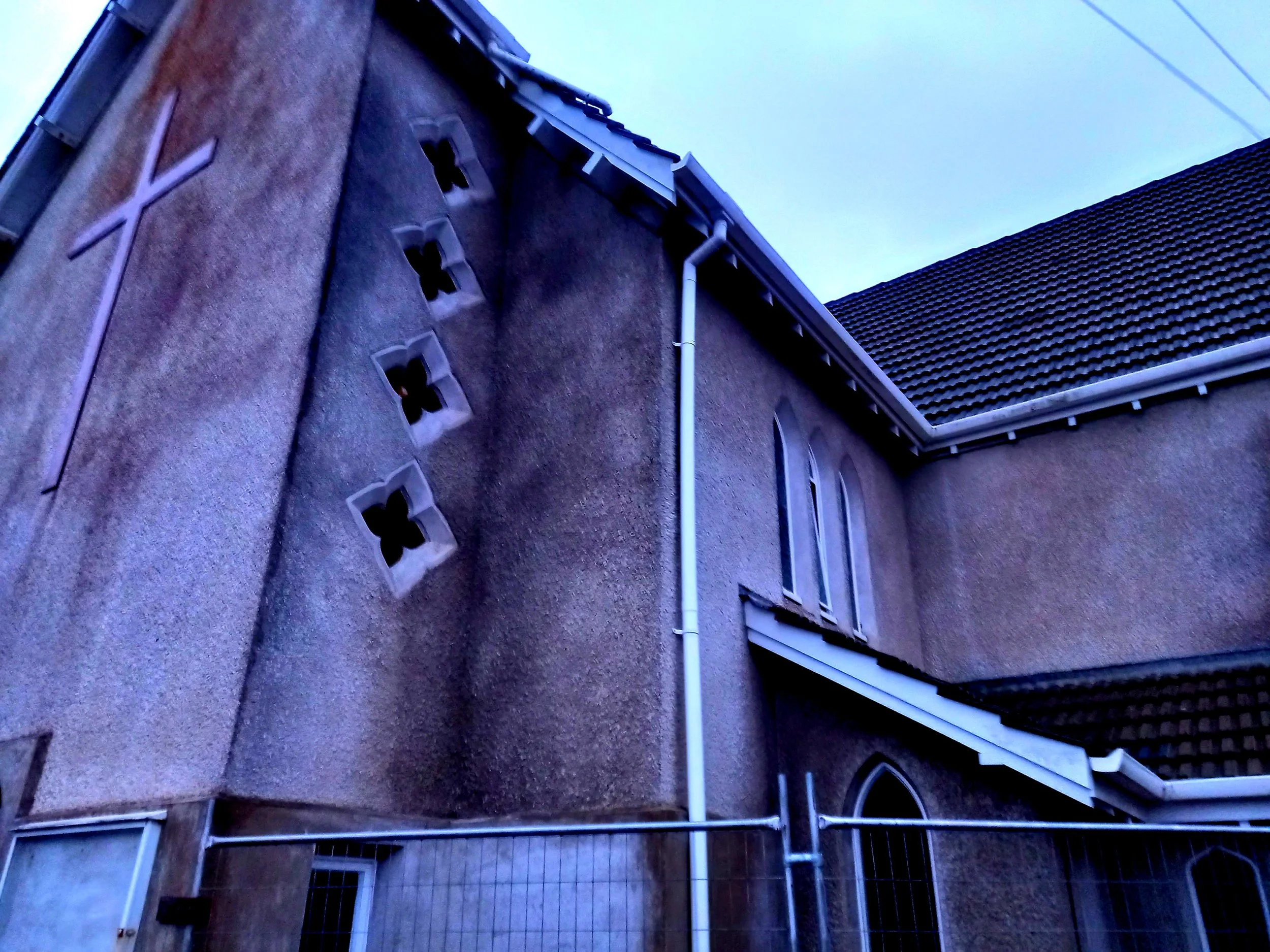
2026 May 11th – Front Building Update
Construction fencing has now been purchased and will be erected at the four corners of the building, as an immediate public safety measure . This will not impede traffic flow nor parking.
This action follows direct instruction from the property representative and further investigations which have confirmed critical and escalating structural safety risks associated with the building. Most concerning is the condition of the roof structure, where concrete tiles have significantly shifted and deteriorated to the point that there is a credible risk of tiles dislodging and falling. Advice received is that this presents a genuine risk of property damage, serious injury, or fatality should collapse occur.
Advice has therefore been clear that immediate progress toward demolition is warranted due to the accelerating deterioration of the structure.
Investigations over the past year have revealed extensive and compounding issues throughout the building, including:
significant cracking and deterioration within walls,
advancing moisture damage,
visible efflorescence (white mineral deposits caused by water penetration),
trentepohlia (red algae growth),
black mould development,
and serious subfloor concerns.
The trentepohlia pathogenic fungus is now insidiously widespread; its airborne spores leave a salty-rusty taste in the throat. Of particular concern has been the discovery that beneath sections of the flooring original pile supports had failed entirely, due to empty kerosene tins filled with sand to make the piles. Rust deterioration over time has contributed to loss of effective support.
A historical parish document dating from approximately 1954 further notes:
“The construction as built in 1921/22 was only partially completed... After the Napier earthquake [1931] the building codes were revised by Wellington City Corporation, and it is doubtful whether the building would have met even the prior codes.”
Wellington City Council has confirmed that:
the building is not heritage listed,
liability for public safety rests with the property owner,
and demolition approval has been granted.
All movable items within the church remain the property of the Diocese and have been carefully itemised, catalogued, and prepared for storage and future use where appropriate.
This has been a deeply difficult process for many people, and we continue to acknowledge the emotional and spiritual significance the building has held across generations. At the same time, our responsibility is to act carefully, lawfully, and safely for the wellbeing of both parishioners and the wider public.
At present, the erection of construction fencing is the necessary immediate step as preparations continue toward demolition.
Thanks to everyone in the community for your ongoing support and understanding.
…………………………………………………………
2026 March 3rd – Plaque & Soil Update
Regarding Plaques and Family Collection Options
As previously communicated, the memorial plaques formerly located on the front lawn at 35 Box Hill were carefully removed, documented, cleaned, and placed into secure storage in anticipation of potential building access and repair work. (see below ‘glossary of terms’ clarifying what has historically taken place, specifically the legal and liturgical ‘scattering/disposal’ of ashes.)
The current members of Vestry are due to complete their elected term in April. While they continue to exercise their responsibilities diligently, they cannot guarantee their personal availability beyond that time, nor can they predict the long-term future configuration or use of parish land.
Although under no legal obligation to do so, Vestry wishes — as a matter of courtesy and pastoral care — to offer families the opportunity to collect memorial plaques and, if desired, a soil sample from the specific location.
To date:
Most next-of-kin have indicated they are satisfied that their family member’s wishes were fulfilled at the time of ‘disposal’, and do not seek any further action.
Some families have chosen to collect the memorial plaque.
Some have collected both the plaque and a soil sample from the precise location.
If you are aware of any family members or descendants who may wish to make arrangements for collection, please encourage them to contact the parish office at:
office@onslowanglicans.org.nz
There is no urgency being imposed; this is simply an invitation extended in goodwill and transparency.
Grace and peace, Onslow Anglicans Vestry (March 3rd, 2026)
…………………………………………………………
………………………………………………………
Appendix 1: Glossary of Terms
(Civil, Local Government, and Anglican Usage)
Ashes (Cremated / Cremains)
Civil:
Ashes are the calcified bone fragments remaining after cremation. They may be:
Buried
Scattered
Retained by family
Placed in a niche or urn vault at a cemetery or columbarium
Subject to landowner permission and local regulation.
Columbarium
Civil:
A columbarium is a structure with niches designed specifically to hold urns containing cremated remains. It must be able to easily relocate urns when the columbarium requires maintenance, is removed, or the site changes ownership. If it is part of a cemetery, it is regulated under cemetery law.
A site does not become a columbarium unless formally constructed and designated as such. There is no columbarium on site at Onslow Anglicans.
Scattering ~ (same as ‘Disposal’)
Civil:
The dispersal of cremated ashes: over land, or buried beneath ground (whether in a sealed box, poured, or sprinkled). Generally permitted with the permission of the landowner or relevant authority.
https://wellington.govt.nz/cemeteries/burials-cremations-and-memorials/cremations/ashes
Wellington City Council uses the legal terms ‘scattering’ and ‘disposal.’
The Anglican Prayer Book uses the liturgical term ‘disposal’.
Church:
Often accompanied by prayers of committal. Scattering/disposal does not create a cemetery nor columbaria.
Disposal ~ (same as ‘Scattering’)
Civil:
A legal term referring to the scattering (sprinkling, pouring, or burial) of ashes by lawful means. It does not imply disrespect. It is administrative language. Once scattering / disposal happens the items are irretrievable, and the process is irreversible.
Church:
The “... disposal of the ashes…” is “... a final letting-go ..” within The Committal of Ashes service. https://anglicanprayerbook.nz/877.html
References:
‘A New Zealand Prayer Book’, p877;
'Earthed in Hope: Dying, Death and Funerals – A Pakeha Anglican Perspective,' by Alister Hendery, p45, 76, 271, 275.]
2026 March 3rd – Building Update - What is happening with the old building?
Walter Brueggemann reminds us that truthful naming of reality leads us through grief and, ultimately, toward hope, whereas clinging to ideals we cannot sustain leads to denial and, in time, despair. In that spirit of pastoral honesty, we want to speak plainly about the reality of our old sanctuary building.
Where we are now
Our building is closed and not safe for public use. Over recent years, pieces of concrete have fallen from the internal walls due to what some builders refer to as the well‑known process called alkali silica reaction. At times this has included a “shrapnel effect,” where fragments of cracked concrete have flown across the space. Because of these safety concerns, and after receiving multiple informal reports, the Diocese Property Team made the decision to close the building until further notice.
Although the building is associated with our parish, the title deed has been handed to the Wellington Anglican Diocese. While we remain emotionally and spiritually connected to the building, decisions about its use and safety now sit at a diocesan level.
What the reports have consistently said
Over time, various assessments have made the same core points:
Significant sums (many thousands of dollars) would be required just to patch fallen or failing concrete.
These costs are well beyond the financial capacity of our parish. Further, we have been directly informed that the Diocese has no cash reserves that could be allocated to this project.
More importantly, patching is not a real solution. Due to the roof needing to be replaced decades ago the walls have reached maximum moisture saturation, and the internal metal framework is rusted.
Engineers and building professionals have been clear in their informal statements: any money spent now would ultimately be wasted.
The hard truth is that the only long‑term solution recommended is demolition (or more nuanced: ‘deconstruction’, repurposing what can be salvaged).
Why nothing is likely to change
In Aotearoa New Zealand, demolition costs are generally covered by insurance only if a building is deemed a total loss or “uneconomic to repair” following a specific insured event (such as fire or natural disaster). Our building, while deeply compromised, could technically be patched, and therefore is unlikely to be formally condemned by the Council or written off by insurers.
At the same time, our parish has no budget capacity to fund maintenance, repairs, demolition, or rebuilding. We also have two other buildings (hall, vicarage) needing maintenance. For these reasons, the most realistic expectation is this: the building will remain closed and unused for the foreseeable future — while still costing us money in rates and insurance.
Naming the grief — and the hope
This is not the future any of us would have chosen. It is right to grieve the loss of a sacred space filled with memory, prayer, music, and sacrament. Grief is not failure; it is faithfulness to what has mattered.
At the same time, our hope has never rested in buildings. ‘The Church’ is not a building, but a people gathered in Christ’s name. We continue to live out the calling of who we are as God’s people and we give thanks that we still have a Hall building to gather in regularly.
We offer this summary not to close conversation, but to ground it in reality, so that whatever hope God grows among us will be honest, resilient, and shared.
A Lament for Our Sanctuary
Faithful God, we come to You naming what is real, not what we wish were true. We bring you the truth of our loss.
We grieve the closing of a place with walls that now fail, concrete that crumbles, a building no longer safe for Your people. We lament what time and decay have taken from us. Deliver us from false hope that leads only to despair.
Give us courage to face what is, and grace to grieve what has been lost. We place our building, our grief, and our future into Your hands. Amen.
FAQs
Q- “Where did all the stuff inside go?” All items that belong to the parish have not gone anywhere.
Q- “My grandfather donated money for the design of one of the stained glass windows. Can I bring a builder to remove it?” No, all items are owned by the parish. Cutting a hole in the wall will cause draft, let alone other problems.